


We have seen many teams try to solve mental overload with longer meetings, more updates, and tighter control. It rarely works. People do not need more noise. They need short moments of reset that help them think, feel, and speak with more order.
Daily micro-meditations are short guided pauses that help teams return to attention, emotional balance, and shared focus.
When we say micro, we mean brief enough to fit real workdays. One minute. Three minutes. Five at most. That small window can change the tone of a meeting, a handoff, or even a full afternoon. We have watched tense groups soften after a single shared breath. Not because all problems vanished, but because minds stopped racing for a moment.
Team clarity is not only about tasks. It is also about emotional state. If people arrive distracted, irritated, or mentally scattered, they hear less, assume more, and react faster than they should. That is why practices linked to mindfulness, emotional development, and applied psychology can support better team interaction in a practical way.
Why micro-meditations work in teams
Short practices lower the barrier to entry. Most people can accept a two-minute pause, even if they would resist a 30-minute session. That matters. A good team ritual must feel possible on busy days, not only on calm ones.
We also know that results should be framed with honesty. A meta-analysis of randomized workplace mindfulness trials found gains in stress, burnout, well-being, and job satisfaction, while direct gains in output were smaller and less steady. This tells us something useful. We should design micro-meditations first for clarity, regulation, and presence. Better work may follow, but that is not the only point.
Clear minds make cleaner decisions.
In our experience, teams respond best when the practice has a direct link to the moment they are in. Before planning, they need focus. After conflict, they need emotional cooling. Before a client call, they need calm and precision. Good design starts there.
Start with the team moment
Before writing a script, we ask a simple question: what mental state does this team need right now? The answer shapes everything.
Most daily team moments fit one of these needs:
- Settling mental noise before a meeting
- Releasing tension after pressure or disagreement
- Sharpening listening before collaboration
- Resetting energy in the middle of the day
- Closing work with reflection and mental separation
If we ignore context, the meditation feels generic. If we match the moment, it feels helpful. That is a big difference.
For example, one team we worked with had fast daily stand-ups, but people kept interrupting each other. The issue was not the agenda. It was scattered attention. A 90-second opening pause changed the pace. They still disagreed. They just did it with more listening.

Build a simple structure
A daily micro-meditation should be easy to lead and easy to repeat. We prefer a four-part structure. It keeps the practice short without making it flat.
Here is the sequence we use most often:
- Arrival. Invite people to stop, sit well, and notice the body.
- Breath. Guide two to six slow breaths with no strain.
- Anchor. Focus on one point such as sound, posture, or intention.
- Return. End with one clear sentence that reconnects the team to the task.
The best micro-meditations do not remove people from work. They reconnect people to work with more presence.
This structure can hold many variations. For a morning check-in, the anchor may be attention. For a creative session, it may be openness. For a hard conversation, it may be steadiness. If you study topics related to consciousness, you will notice that even a brief shift in awareness can change how a group interprets the same event.
Keep the language direct and human
Many scripts fail because they sound distant or overly soft. Teams need language that respects time and feels real. We avoid abstract phrasing when a simple sentence will do.
Try lines like these:
- “Let your shoulders drop.”
- “Notice one breath from start to finish.”
- “Release the last meeting.”
- “Bring your attention back to what matters now.”
Short sentences work well because people can follow them without effort. A rushed mind does not absorb long instructions. We have seen this again and again.
It also helps to avoid any tone that feels imposed. Invite rather than command. People open more when the practice feels respectful.
Match the duration to the setting
Not every micro-meditation should take the same time. We like to match length to the pressure and the purpose of the moment.
A useful guide looks like this:
- 1 minute for transitions between meetings
- 2 to 3 minutes before team alignment or planning
- 3 to 5 minutes after conflict, fatigue, or heavy decision work
Consistency matters more than length.
A team that practices for two minutes each workday often gets more value than a team that does one long session every few weeks. Rhythm teaches the nervous system what to expect. Soon the pause itself becomes a signal. Stop. Breathe. Recenter. Continue.
Design themes for the workweek
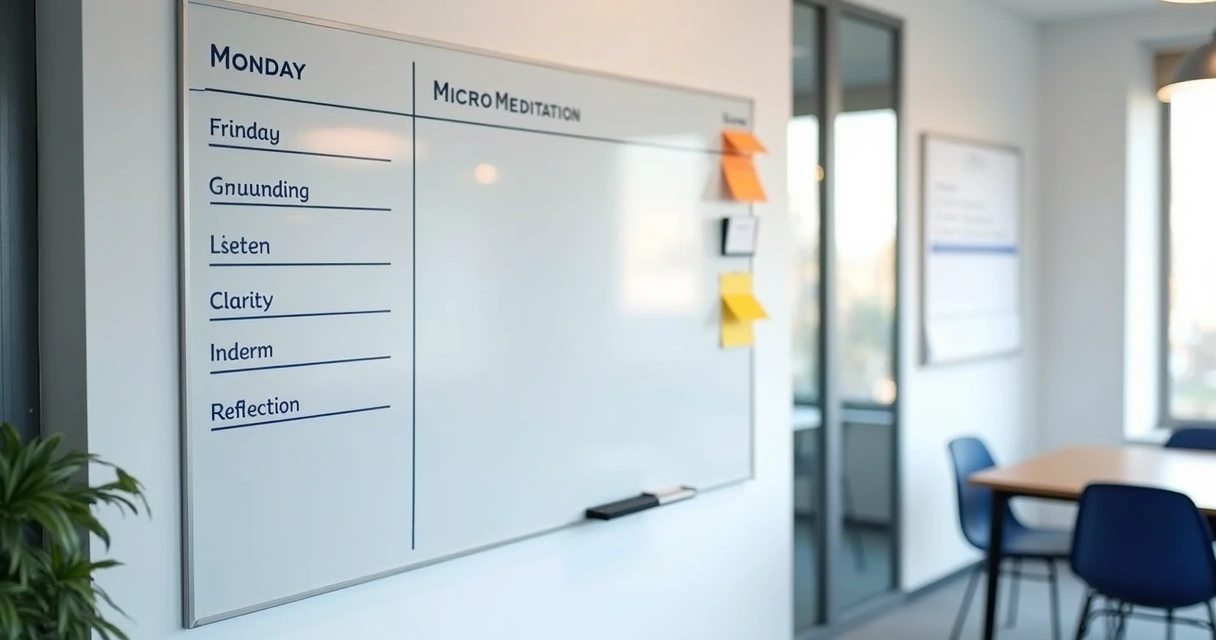
One helpful method is to assign a simple theme to each day. This creates variety without making the practice hard to manage. Teams also start to look forward to the rhythm.
We might shape a week like this:
- Monday: grounding and intention
- Tuesday: listening and patience
- Wednesday: reset and energy balance
- Thursday: clarity under pressure
- Friday: reflection and release
This pattern supports team culture, not only attention. It connects well with stronger habits of leadership because leaders model emotional steadiness when they make room for a conscious pause instead of reacting on impulse.
Test, observe, and refine
Once the practice is in place, we do not assume the first version is the best one. We watch what happens. Are people more present? Does the room settle faster? Does the opening of meetings feel less fragmented?
We listen for practical feedback such as:
- “That felt too long before a short call.”
- “The breathing helped, but the wording felt formal.”
- “I could focus better after the pause.”
- “The Friday reflection helped me end the day cleanly.”
Even small comments help improve the design. We are not trying to create a perfect script. We are shaping a living team ritual.
Common mistakes to avoid
Some teams stop because they make the practice heavier than it needs to be. We try to keep it free from common traps.
- Making the meditation too long for the schedule
- Using vague or overly complex wording
- Forcing participation without emotional safety
- Changing the format every day with no stability
- Expecting instant changes in all team behavior
A short pause can help a lot. Still, it is one support among others. Team clarity also depends on good communication, emotional maturity, and healthy structure.
Conclusion
When we design daily micro-meditations well, we give teams a repeatable way to return to themselves before returning to each other. That shift can be subtle. It can also be felt right away. Fewer rushed words. Better listening. Cleaner thought.
A strong micro-meditation is brief, relevant to the moment, and easy to repeat every day.
We think the best designs are not dramatic. They are steady. They fit the workday, respect people’s limits, and gently build a culture of clearer presence over time. If a team can pause together for even two minutes with sincerity, that is already a meaningful start.
Frequently asked questions
What are micro-meditations for teams?
Micro-meditations for teams are short guided pauses, often lasting one to five minutes, used during the workday to calm mental noise, support emotional balance, and improve shared attention. They can happen before meetings, after tense moments, or during transitions between tasks.
How to create effective daily micro-meditations?
We create effective daily micro-meditations by matching the practice to the team’s immediate need, keeping the structure simple, and using clear language. A good format includes arrival, breathing, one mental anchor, and a brief return to the task. It should feel natural and easy to repeat.
What are the benefits for team clarity?
The main benefits for team clarity include better focus, calmer communication, improved listening, and fewer reactive responses. These short pauses can help people enter discussions with more order in their thoughts and more awareness of their emotional state.
How long should a micro-meditation take?
Most micro-meditations should take between one and five minutes. Short transitions may need only one minute, while moments after pressure or conflict may benefit from three to five minutes. The right length depends on the setting and whether the team can sustain the habit each day.
Can micro-meditations boost team productivity?
They can support better work by improving focus, reducing mental strain, and helping teams communicate more clearly. Still, direct gains in output are not always strong or immediate. It is better to see micro-meditations as a support for clarity and steadiness, which can later help the quality of team performance.